
Top-level lab gears up to study Ebola virus

With French assistance in laboratory design, establishing biosafety standards and personnel training, construction started in 2011 and lasted for three years.
"The brand new lab in Wuhan, as one of the country's large-scale science facilities, will play an important role in our public health defense system, and will be an indispensable technology platform for the global prevention and control of infectious diseases," said Bai Chunli, president of the Chinese Academy of Sciences.
Bai said a number of research teams from China and France have cooperated on studies into Ebola, the Marburg virus and HIV, which has laid a solid foundation for further cooperation.

The lab will be put into service after a trial operation, and will be open to scientists around the world.
Alain Merieux, president of Foundation Merieux, a public health foundation, said the joint P4 program has not only vividly embodied the depth and strength of the ties between France and China, but also the responsibility to the world community.
"Globalization has cast tremendous pressure on prevention and control of emerging and re-emerging diseases. Thus a united world society is a must to win over the challenge to public health and sustained development of human beings.
"By helping Chinese colleagues with the world class designing, and architecture technology, of biocontainment facilities, France has expanded its front line of disease prevention and control," he said.
chengyingqi@chinadaily.com.cn
|
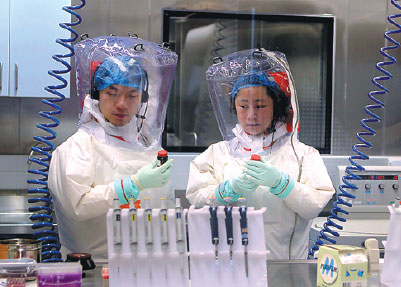
Researchers work on a test in China's first laboratory to study highly contagious and fatal diseases. The country's first biosafety level-4 laboratory was inaugurated in Wuhan, capital of Hubei province, on Saturday and will enable scientists to research live Ebola viruses. Zou Hong / China Daily |


- Plan to boost eye care services by 2030
- China sees wider healthcare access as system continues to grow
- China moves to further improve family doctor services
- China targets better health for all by 2030
- China targets average life expectancy of 80 by 2030 in new five-year health plan
- The number of assisted reproductive institutions reaches 645 in China