
Family planning commission 'satisfied' with birth rate
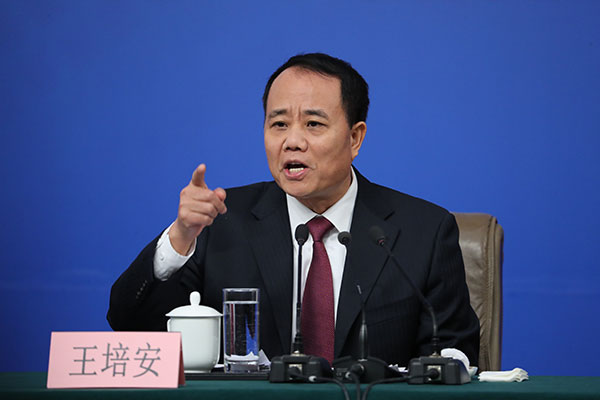
Wang Pei'an, deputy minister in charge of the National Health and Family Planning Commission, answers questions at a press conference for the fifth session of the 12th NPC in Beijing, March 11, 2017. [Photo/Xinha]
China's second-child policy pushed the fertility rate up to more than 1.7 last year, an increase from between 1.5 and 1.6 between 2000 and 2015, Wang Pei'an, deputy minister in charge of the National Health and Family Planning Commission, told a news conference on March 11.
More than 18.4 million babies were born in China last year, 2 million more than the annual number of new births for the previous five years, and the highest number since 2000, Wang said.
The fertility rate is the average number of children a woman gives birth to in her lifetime.
"The second-child policy has produced satisfactory results," Wang said. "They totally met our expectations."
More than 90 million couples became eligible to have a second child under the new policy, but only 28 percent of them are expected to have a second baby due to old age or unwillingness to have a bigger family, he said.
China is not lacking in population and even by the end of the century China's population will remain at more than 1.1 billion, Wang said.


- Plan to boost eye care services by 2030
- China sees wider healthcare access as system continues to grow
- China moves to further improve family doctor services
- China targets better health for all by 2030
- China targets average life expectancy of 80 by 2030 in new five-year health plan
- The number of assisted reproductive institutions reaches 645 in China