
'Corridor classroom' provides a teaching tonic for leukemia kids
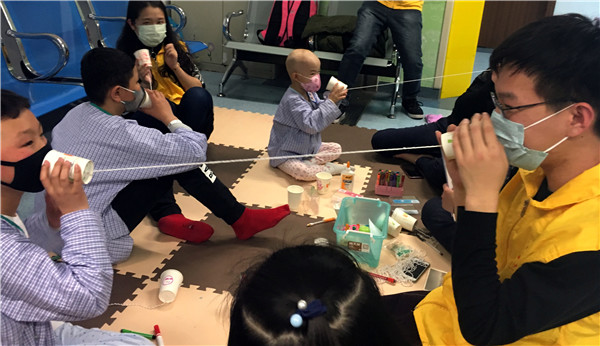
Volunteers help children to use "telephones" made from paper cups and string to explain how sound waves move. [Photo/Xinhua]
The children are ages 2 to 14, and their classroom always smells of disinfectant. They all wear masks. Few have hair, but those who do have just a few thin strands. They all have leukemia.
Every year, about 15,000 children in China are diagnosed with leukemia, a form of cancer caused by overproduction of damaged white blood cells. Most are ages 2 to 7, and their treatment usually lasts two to three years.
In addition to enduring the pain of bone marrow treatments and chemotherapy, their immune systems are impaired, leaving the children at risk of infection, so they have to say goodbye to a normal life. The disease confines them to hospital wards or home, isolating them from the outside world.
At Peking University First Hospital in downtown Beijing, 80 percent of the child patients with leukemia come from other parts of China. To help them continue their studies, the Beijing New Sunshine Charity Foundation has cooperated with the hospital to run a free school since 2012.
The classroom, a public space in a corridor, welcomes children of all ages. Generally, a full-time teacher and student volunteers give two classes every week, each lasting 90 minutes. Courses at the "corridor classroom" include Chinese, math, English, arts, health and science.
The idea was inspired by Zuo Yan from Anhui province. When the then-8-year-old was diagnosed with aplastic anemia a decade ago, the foundation sponsored his treatment in Beijing. Volunteers found a picture he had drawn of his school days that carried the caption, "I miss school." That set the idea in motion.


- Plan to boost eye care services by 2030
- China sees wider healthcare access as system continues to grow
- China moves to further improve family doctor services
- China targets better health for all by 2030
- China targets average life expectancy of 80 by 2030 in new five-year health plan
- The number of assisted reproductive institutions reaches 645 in China