
China's homegrown anti-cancer drug wins international recognition
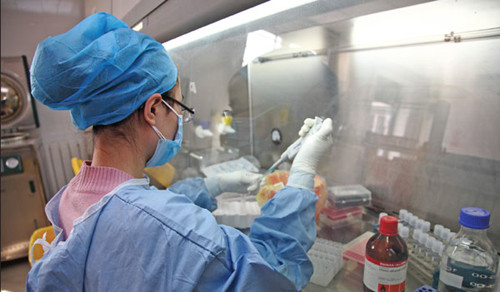
An employee conducts research at a biomedical information center in Beijing. [Photo by Zhang Bei/For China Daily]
BEIJING -- China's homegrown drug Sintilimab designed for treating relapsed or refractory classic Hodgkin lymphoma has won international recognition, with its clinical trial research published as the cover paper in the January issue of The Lancet Haematology.
Hodgkin lymphoma is a rare malignant lymphoma that occurs mostly in young people between the ages of 20 and 40. Although the cure rate of early treatment is high, patients have a 20 percent chance of recurrence after their first treatment. Patients with relapsed or refractory classic Hodgkin lymphoma lack effective treatment in China.
Sintilimab, an anti-PD-1 drug, is a kind of checkpoint inhibitor, an emerging anti-cancer therapeutic modality that boosts the immune system to help the body target and kill tumors.
Professor Shi Yuankai from the Cancer Hospital, Chinese Academy of Medical Sciences, led the clinical research, which enrolled 96 patients with relapsed or refractory classic Hodgkin's lymphoma from 18 hospitals in China.
Results showed that Sintilimab has favorable activity and acceptable toxicity in Chinese patients with relapsed or refractory classical Hodgkin lymphoma, with 80.4 percent of the patients showing an objective response.
Stephen M Ansell from the Division of Hematology at the Mayo Clinic commented that Sintilimab is a "highly effective treatment which potentially improves the outcomes of patients with classical Hodgkin lymphoma worldwide."
Sintilimab was approved for market authorization by China's National Medical Products Administration in December 2018.
"The approval will bring more treatment options for cancer patients in China," Shi said.


- Plan to boost eye care services by 2030
- China sees wider healthcare access as system continues to grow
- China moves to further improve family doctor services
- China targets better health for all by 2030
- China targets average life expectancy of 80 by 2030 in new five-year health plan
- The number of assisted reproductive institutions reaches 645 in China