
China's health insurance program helps 5 million rural families out of poverty
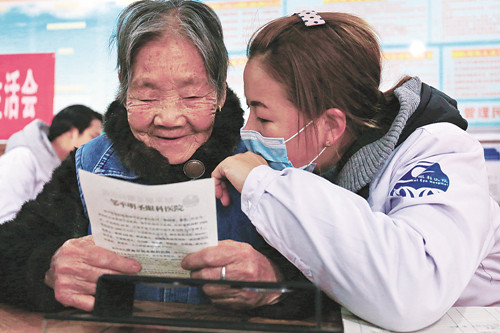
A nurse explains an eye test to an elderly woman at a hospital in East China's Shandong province. With an aging population, China is seeing more opportunities for healthcare providers that specialize in goods and services for the elderly. IMAGINECHINA
BEIJING -- About 5.81 million rural families impoverished due to illness-related expenses have been lifted out of poverty since China initiated a new health insurance program in 2016, according to Wang Hesheng, deputy director of the National Health Commission at a poverty-alleviation forum in Beijing Oct 18.
In 2017, registered poverty-stricken patients only had to pay an average of 15.8 percent of their medical expenses, a decrease of 26.6 percentage points compared to 2016.
Since the initiation of the program, a total of 9 million poverty-stricken patients have received targeted medical treatment as an annual average of 30,000 doctors from city hospitals were sent to perform their duties in hospitals located in poverty-stricken areas.
A report released by the China Population and Development Research Center showed that as of 2017, 8.04 million out of 8.49 million impoverished patients have received medical treatment.
China views illness-caused poverty a great challenge in the country's battle against poverty and issued guidelines on carrying out medical insurance programs in impoverished rural areas in 2016.


- Plan to boost eye care services by 2030
- China sees wider healthcare access as system continues to grow
- China moves to further improve family doctor services
- China targets better health for all by 2030
- China targets average life expectancy of 80 by 2030 in new five-year health plan
- The number of assisted reproductive institutions reaches 645 in China